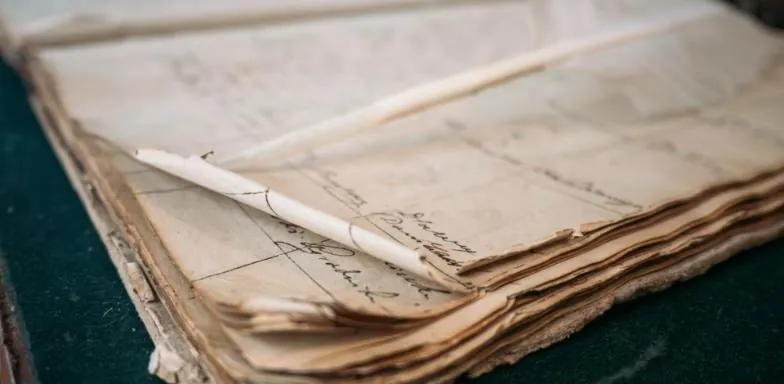
1. Find the entry in an index
Start with Geneteka, the Polish Genealogical Society's index, which holds over 31 million entries. Search by surname and parish, and note the year and act number. Then open the original book on szukajwarchiwach.gov.pl, the State Archives' scan portal with over 55 million images (NAC).
If the parish isn't indexed, browse the book year by year. Most books have an alphabetical index at the end of each year.
2. Know which language to expect
The language depends on where and when the record was written:
- Galicia (Austrian partition: Kraków, Rzeszów, Lviv): mostly Latin, in printed column forms. Some Greek Catholic books are in Ukrainian.
- Russian partition (Warsaw, Łódź, Lublin, Białystok): Polish narrative paragraphs, switching to Russian Cyrillic in the later 19th century.
- Prussian partition (Poznań, Gdańsk): German civil registers from 1874, alongside parish books in Latin or Polish.
3. Read the key fields
Whatever the language, a birth or baptism entry gives the same facts:
| Field | Latin | Russian | Polish |
|---|---|---|---|
| Child | infans | младенец | dziecię |
| Father | pater | отец | ojciec |
| Mother | mater | мать | matka |
| Born | natus / nata | родился | urodził się |
| Godparents | patrini | восприемники | chrzestni |
| House number | numerus domus | дом № | numer domu |
Copy every name exactly as written, including Latin forms such as Joannes for Jan. Note the mother's maiden name, the parents' ages, and the house number. These help you match records across generations.
4. Write down the archive reference
To order a certified copy you need the full reference: archive name, fonds (zespół), file signature (sygnatura), year and act number. Archives issue copies from that reference. Without it, they search on your behalf and charge for the time.
5. Use tools, then check by eye
Handwriting recognition now works on old Polish script. Transkribus has a public Polish model trained on historical and modern handwriting. Treat its output as a first draft. Names and dates must be checked by a person, because one wrong letter can send a search to the wrong family.
6. Which records a citizenship case needs
A scan you found online is a research copy. For the citizenship application you need a certified copy or extract from the archive or civil registry office, plus a sworn Polish translation of any non-Polish document. Records under 100 years old (births) or 80 years old (marriages and deaths) are usually still at the local civil registry office, not the State Archives. See Polish birth records.